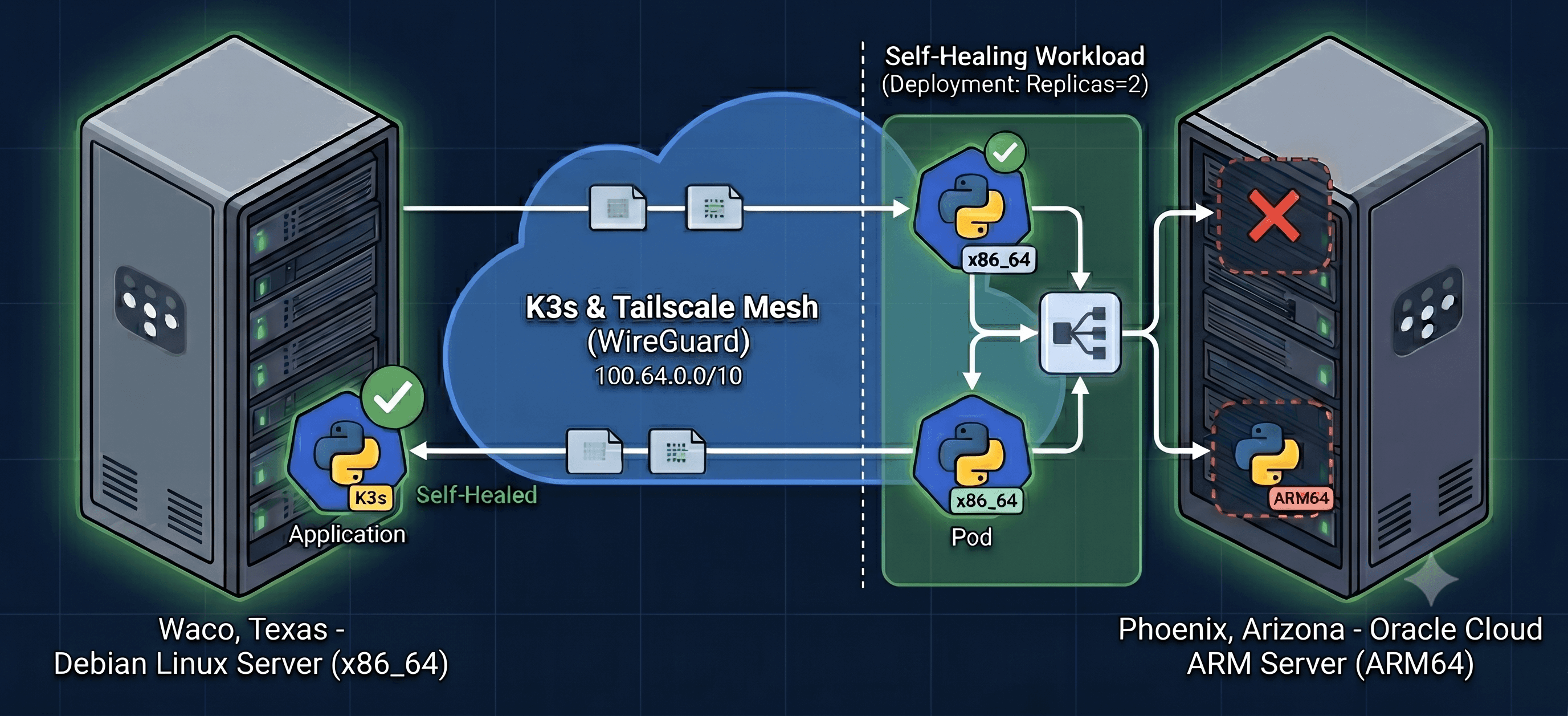
A technical architecture diagram of a two-node hybrid-cloud Kubernetes cluster using K3s. On the left, a server tower node is labeled 'Waco, Texas - Debian Linux Server (x86_64)'. On the right, a matching server tower node is labeled 'Phoenix, Arizona - Oracle Cloud ARM Server (ARM64)'. The two nodes are linked across a central blue cloud graphic labeled 'K3s & Tailscale Mesh (WireGuard) 100.64.0.0/10'. The diagram illustrates a self-healing application deployment (Replicas=2); one Python application pod runs smoothly on the Waco node, while a red 'X' on the Phoenix node shows a simulated pod failure, with an arrow demonstrating the automated self-healing orchestration spinning up a replacement pod across the secure mesh network.

Part 3: A Two-Region Kubernetes Cluster with K3s, Multi-Arch Builds, and Self-Healing Workloads

How I turned a laptop in Texas and an ARM server in Arizona into a single Kubernetes cluster — joined over Tailscale, running a multi-architecture workload that survives a node going dark. A step-by-step build guide, plus the moment I realized my monitoring couldn't tell me when my home lost internet, and how I fixed it.